
My
wife Tannie and I have never had a better holiday than the ten days we recently
spent in Bali. We had earlier greatly enjoyed the splendors of Egypt, the
wonders of Turkey, the temptations of Europe and the joys of ocean cruises but
Bali is a place that we want to go back to see again. Thailand offers a much greater
variety of places to visit, things to do but you know that you are in a foreign
land. Although Bali is exotically foreign it also offers a feeling of human
warmth. And, for Indians, a deep river of an ancient common culture is also
seductively alluring.
Do
not however expect a tropical paradise for there are better beaches, more fun
and greater variety of food in many other countries. The Indonesian Rupiah is
also initially very scary. There are so many Zeros in the 50,000 Rupiahs you one
need to spend on a taxi ride until you realizes that it is just 4 US dollars.
After understanding this, the costs of hotels, food, shopping and excursions
suddenly become very affordable. Many also fear that Bali will be hot in summer
forgetting that it is near the equator that makes the climate pleasant
throughout the year. There is a great deal to see and do in the island that is
about 150 kms from east to west and 100 kms from north to south. All the
beaches are beautiful and the lush green fields and thick forests covering the
hilly terrain are a delight.
Bali
is predominantly Hindu and there are numerous beautiful red and gold Hindu
temples every few kilometers. Lovely examples of Hindu piety are also visible
in every house of hotel where colorful rituals are performed every day. We were
lucky to witness a most beautiful purification ceremony at our hotel. Hinduism
came to Indonesia about 1500 years ago when the great Hindu kingdoms of the
Srivijayan and Shailendra kings were established in Sumatra mainly influenced
by the cultures of ancient Orissa and Tamilnadu. Brahmin priests with magnificent
rites of kingship were eagerly sought by every local chieftain. Though Buddhism
followed it many great Hindu temples still survive. Islam was then brought to
Indonesia by Arab traders about 600 years ago but the island of Bali remained
staunchly Hindu. It was however an archaic Hinduism of about a thousand years
earlier and gradually became a bit different from the Hinduism that evolved in
different parts of India.

The
world’s only temple of Varuna, the `purvi devta’ or pre Vedic divinity of water,
is just off the coast at Tanah Lot in the south west. This beautiful temple built
on a rocky spur lapped by the surging waves of the ocean is truly spectacular.
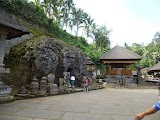
At Ubud in the centre of the island is a 9th century Goa Gajah
temple devoted to Ganesh carved inside a cave. Outside this temple there are
sacred tanks fed by a spring. In the ancient Puranic Indian tradition all the
water of the world came from Ganga the sacred cosmic river that came to earth
through the matted locks of the god Shiva and then splashed out to create all
the springs of the world that were channeled through the mouths of cows
(gaomukh) or water vessels held by celestial nymphs. At Goa Gajah the waters of
the spring pour out of little vessels carried lovingly by six celestial maids.
As
in India the Balinese Hindus cremate their dead but only the Brahmins are
burned immediately. Most Balinese are from the lesser castes and their bodies are
buried for eleven months until their souls are pure and their bones are then
cremated in a grand but very expensive ceremony. There are many other customs
similar but not the same as those of Indian Hindus.
We
went to Bali on a well organized and affordable six day package tour. We first
stayed at an excellent 4-star hotel at Legian on the west coast that is full of
bars, spas and discos. The package provided us a good small car to take us around
and included a Barong Kris dance based on the Ramayana with a long haired
two-man tiger and a mischievous Hanuman. Huge and very colorful silk kites filled
the skies everywhere in the constant breeze.
We
drove through terraced paddy fields to Kintamani where there was a great view
of a dormant volcano and lake Batur. We also visited several very interesting
temples and workshops making the most delicate gold and silver jewelry.
Needless to say we swam in the sea and spent a day doing water sports. The package
included a short cruise around the harbor. At the end of the planned trip we
spent three extra days at a lovely 5-star hotel at Sanaur on the east coast.
This was a quieter beach on a extended lagoon behind a long coral reef that
broke the great waves of the Pacific Ocean. Balinese food was very good but
lacked the huge variety that Thailand offers.

We
were also very fortunate to meet a lovely Balinese couple who showed us many
aspects of Bali culture that a normal tourist would never see including an
amazing cultural festival in which over a thousand amateur musicians and
dancers enthusiastically participated. Bali is also the one foreign place that
treats Indians as highly honored guests.

